Edgefield County Dog Registration Information
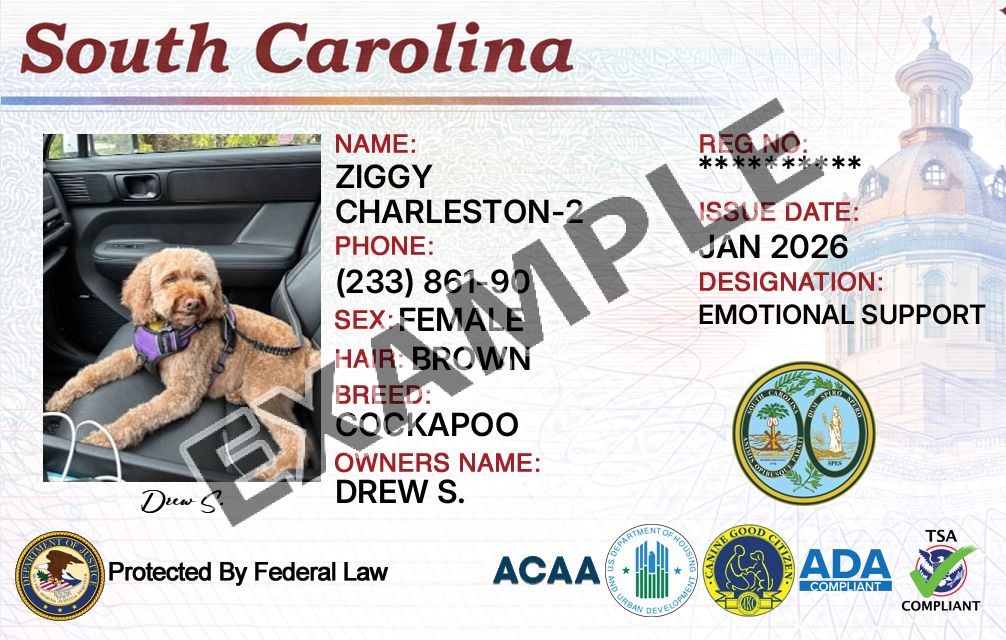
Service Dogs and Emotional Support Animals in Edgefield, South Carolina
Registering a Dog in Edgefield County, South Carolina (Service Dog or Emotional Support Dog)
If you’re asking where do I register my dog in Edgefield County, South Carolina for my service dog or emotional support dog, the key is to separate two different things: (1) local dog licensing/identification and rabies compliance (handled locally), and (2) federal/state rules that define whether a dog qualifies as a service dog or an emotional support animal (ESA). In most cases, you will start with your local animal control or county office for a dog license in Edgefield County, South Carolina (or county-required identification) and make sure your dog is current on rabies vaccination.
Where to Register or License Your Dog in Edgefield County, South Carolina
Because licensing is often handled at the county or city level, below are example official public offices that may handle (or direct you to) local licensing, animal control enforcement, rabies-related bite reporting, and identification requirements in Edgefield County, South Carolina. If you’re unsure which office applies to your address (town vs. unincorporated areas), start with Animal Control/Sheriff’s Office and ask where to obtain the correct local tag or registration.
Local & State Offices (Examples)
| Office | Address | Phone | Hours | Typical Role | |
|---|---|---|---|---|---|
| Edgefield County Sheriff’s Office |
264 Star Rd Edgefield, SC 29824 |
(803) 637-5337 | Not listed | Not listed | General law enforcement and community contact point; can help route animal control questions (including animal control dog license Edgefield County, South Carolina questions). |
| South Carolina Department of Public Health (DPH) – Rabies Contacts (Midlands Region serving Edgefield County) |
206 Beaufort Street NE Aiken, SC 29801 |
(803) 642-1687 | Midlands-Rabies@dph.sc.gov | Monday–Friday, 8:30 A.M.–5:00 P.M. | Rabies-related guidance and reporting (especially for bites/exposures) and public health coordination. |
| South Carolina Department of Public Health (DPH) – Edgefield County Animal Bite Reporting (Business Hours) | Not listed (county contact line) | (803) 642-1637 | Not listed | Not listed | County-specific bite reporting line used for rabies exposure response coordination. |
| South Carolina Department of Public Health (DPH) – Edgefield County Animal Bite Reporting (Fax) | Not listed (county fax) | (803) 643-4027 | Not listed | Not listed | Fax line associated with county bite report routing. |
Overview of Dog Licensing in Edgefield County, South Carolina
What “Registering” Usually Means in Edgefield County
In South Carolina, there is no single statewide pet “registration” system for all dogs. Instead, local governments typically manage animal control enforcement, and they may require dog owners to keep dogs properly identified and compliant with rabies laws. In Edgefield County, the county animal control ordinance requires dogs to wear identification so the owner can be positively identified. Acceptable identification can include a current rabies tag, a name plate, a tattoo, or a microchip (with the ability to identify the owner). For many residents, that rabies tag (issued when your veterinarian vaccinates your dog) is the practical starting point for compliance.
Rabies Vaccination Is the Foundation
South Carolina’s rabies law requires owners to keep dogs current on rabies vaccination. Vaccines may be annual or multi-year depending on the product label used by your veterinarian, but the requirement is that your dog’s rabies vaccination is up to date. When you vaccinate, your veterinarian typically provides a rabies certificate and a rabies tag—both of which can be requested by animal control or law enforcement.
Why Some Residents Hear “License,” “Tag,” or “Registration”
People often use “license” to mean one of these:
- Rabies tag (issued by the veterinarian after vaccination)
- Local dog license (a county or municipal tag/permit, if your local jurisdiction issues one)
- Identification requirement (proof your dog can be tied back to you if found loose)
How Dog Licensing Works Locally in Edgefield County, South Carolina
Step-by-Step: Where to Register a Dog in Edgefield County, South Carolina
- Confirm your jurisdiction (town vs. unincorporated county). Edgefield County’s ordinance applies broadly, but incorporated areas can have their own local rules. If you live inside a town’s limits, ask whether the town has additional requirements.
- Make sure rabies vaccination is current. Ask your veterinarian for the rabies certificate and tag and keep a copy for your records.
-
Contact local animal control / sheriff’s office to confirm whether a separate county license tag is issued.
If a local tag is required, ask:
- Where to apply (in person vs. by mail)
- What proof is required (rabies certificate, ID, proof of residency)
- Fees (if any) and renewal timing
- Whether service dogs receive any fee waiver or special tag (not all counties do, and requirements vary)
- Keep ID on the dog. Edgefield County requires identification forms such as a current rabies tag, name plate, tattoo, or microchip. Even if a “license” isn’t a separate item, the identification requirement can function like the practical “registration” the public is looking for.
What Animal Control Typically Enforces
Local animal control and law enforcement commonly address issues such as:
- Animals running at large (leash/restraint rules)
- Proof of rabies vaccination when needed
- Identification requirements to connect dogs to owners
- Bite incidents and quarantine requirements coordinated with public health
Rabies Exposure, Bites, and Quarantine (Why DPH May Be Involved)
If a dog bites a person or there is a possible rabies exposure, public health involvement may be required. South Carolina public health maintains county/region contacts for rabies reporting and guidance. This is separate from “licensing,” but it is part of what people mean when they ask about “rabies enforcement.”
Quick clarity for searchers
If your goal is simply: “where do I register my dog in Edgefield County, South Carolina”—start with current rabies vaccination and then confirm with local animal control whether there is a separate county-issued dog license tag in addition to the rabies tag.
Service Dog Laws in Edgefield County, South Carolina
Service Dogs Are Not “Registered” by a Website
A service dog is defined by what the dog is trained to do for a person with a disability (task-trained assistance), not by a paid registry, online certificate, or ID card. You generally do not need a special “service dog registration” to have a legitimate service dog. Many third-party registries are not official and are not required for legal recognition.
How a Service Dog Interacts with Local Licensing
Even if a dog is a legitimate service dog, local public health and animal control rules still apply: the dog should be current on rabies vaccination and meet any lawful local identification requirements. Put another way: service dog status is about access rights and disability law, while a local dog license in Edgefield County, South Carolina (or identification requirement) is about public health and animal control administration.
What Businesses May Ask (Practical Summary)
In public accommodations, staff typically may ask limited questions when a service dog’s role isn’t obvious (for example, whether the dog is required because of a disability and what work/tasks the dog is trained to perform). They generally cannot require proof of certification, a vest, or an ID card as a condition of entry. Local “license tags” or rabies tags may still be required by animal control rules, but they are not the same as service-dog legal status.
Emotional Support Animal Rules in Edgefield County, South Carolina
An ESA Is Not the Same as a Service Dog
An emotional support animal (ESA) provides comfort by its presence and is typically supported by clinical documentation for certain settings (commonly housing). ESAs are not task-trained service dogs under disability access rules for public places, and they do not automatically have the same public access rights as service dogs.
Do You “Register” an ESA with the County?
In most cases, there is no official county “ESA registry.” If you see a website selling ESA registrations, certificates, or ID cards, that is not the same as meeting legal requirements. For local compliance, your dog still needs to follow the same basic public health and animal control rules as other dogs: current rabies vaccination and required identification.
Housing vs. Public Access (Why This Matters)
Many ESA questions come from housing situations. The rules that apply in housing can be different from rules for restaurants, stores, and other public accommodations. Regardless of the setting, a dog should remain properly vaccinated and identifiable in line with local animal control expectations in Edgefield County.
Frequently Asked Questions
Register A Dog In Other South Carolina Counties
Select your county below to get started with your dog’s ID card. Requirements and license designs may vary by county, so choose your location to see the correct options and complete your pup’s registration.
- Abbeville County Dog Registration
- Aiken County Dog Registration
- Allendale County Dog Registration
- Anderson County Dog Registration
- Bamberg County Dog Registration
- Barnwell County Dog Registration
- Beaufort County Dog Registration
- Berkeley County Dog Registration
- Calhoun County Dog Registration
- Charleston County Dog Registration
- Cherokee County Dog Registration
- Chester County Dog Registration
- Chesterfield County Dog Registration
- Clarendon County Dog Registration
- Colleton County Dog Registration
- Darlington County Dog Registration
- Dillon County Dog Registration
- Dorchester County Dog Registration
- Fairfield County Dog Registration
- Florence County Dog Registration
- Georgetown County Dog Registration
- Greenville County Dog Registration
- Greenwood County Dog Registration
- Hampton County Dog Registration
- Horry County Dog Registration
- Jasper County Dog Registration
- Kershaw County Dog Registration
- Lancaster County Dog Registration
- Laurens County Dog Registration
- Lee County Dog Registration
- Lexington County Dog Registration
- Marion County Dog Registration
- Marlboro County Dog Registration
- McCormick County Dog Registration
- Newberry County Dog Registration
- Oconee County Dog Registration
- Orangeburg County Dog Registration
- Pickens County Dog Registration
- Richland County Dog Registration
- Saluda County Dog Registration
- Spartanburg County Dog Registration
- Sumter County Dog Registration
- Union County Dog Registration
- Williamsburg County Dog Registration
- York County Dog Registration